Excavations 1972
The excavations of the barracks by John Pearson Gillam, R M Harrison and T G Newman is detailed in the 6-page report published in Archaeologia Aeliana series 5, volume 1, page 81-85, 1973.
In 1972, Newcastle University conducted a preliminary excavation. The dig focused on a 42-square-metre area along the via quintana (an internal road) and aimed to explore lesser-known parts of the fort, particularly the barracks, rather than the more studied gates and central buildings.
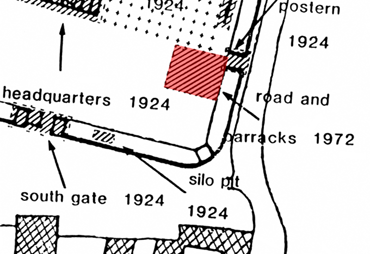
Excavations 1972
Click here for the full publication in a new window:

Gillam 1972
Click here for the full publication in a new window:
Three building phases were identified, including two successive barrack blocks. The earliest, likely built during Hadrian’s reign, showed signs of standard Roman military layout. Based on its dimensions, the structure may have housed a cohors quingenaria equitata—a mixed infantry and cavalry unit. This first barrack was later destroyed by fire, with evidence including scorched pottery, burned wood, and heat-distorted window glass. The most recent datable pottery suggested the fire occurred around AD 180.
A second barrack (Period II) was built on the same footprint with minor structural changes. It too fell into disrepair, probably by the late 3rd century. A single stone dating to the late 4th century suggests a later reoccupation of the site, in line with similar findings at other Wall forts.
Crucially, the excavation revealed deep pre-Roman plough-marks beneath the Roman levels, running in multiple directions and forming shallow rig patterns. These indicate that the land was actively farmed shortly before the fort’s construction—challenging assumptions about the agricultural limitations of Northumberland’s clay soils in the Iron Age. Comparable evidence from other Roman sites supports this view.
Overall, the 1972 excavation at Rudchester shed new light on the fort’s development, destruction, and reuse, while also contributing important evidence about pre-Roman land use and population density in the region.