Excavations 2022
In September 2022, an archaeological watching brief was carried out during drainage works at Rudchester Farm, Northumberland. The work involved monitoring the excavation of a 150m-long service trench using a small mechanical excavator. The trench followed the route of a pre-existing service run, extending north-south before turning west near the ‘Dutch’ barn.
The trench, approximately 0.25m wide and 0.60m deep, revealed uniform deposits of mid to dark grey-brown silty sand throughout. This material likely represents backfilled or redeposited ploughsoil from earlier pipe installations. The trench contained two plastic pipes (black and blue), indicating the service run had been excavated and re-excavated previously. No distinct trench cuts were visible, supporting the interpretation that earlier works had been backfilled with the same material.
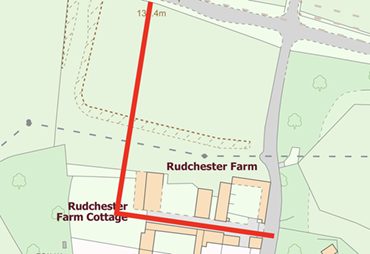
Rudchester Water Supply 2022
Click here for a high resolution scan in a new window:
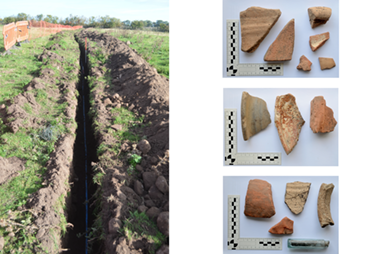
Trench across Fort
Click here for higher resolution photograph in a new window:
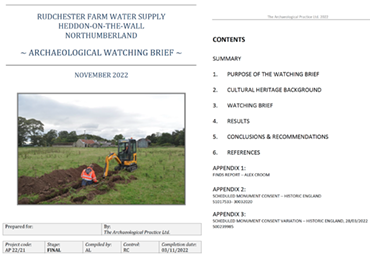
Watching brief
Click here for the full pdf document in a new window:
Two stone obstacles ([102] and [103]) were uncovered where the pipes came too close to the surface. These stones were recorded and later removed under guidance from Historic England. They were interpreted as rubble or isolated flagstones, not part of any in situ structure.
One potential in situ feature — a linear stone face ([104]) — was observed near the northern end of the trench but was not impacted during works. At the southern end, a section of a partially collapsed drystone wall was deconstructed. This wall contained 19th–20th century artefacts, including a glass vessel and spoon.
Several Roman ceramic finds, including large amphora and mortaria sherds, were recovered from the spoil, likely displaced during earlier unmonitored pipe installations. No undisturbed archaeological deposits were encountered.
Conclusion
The drainage works did not impact any significant archaeological remains. However, given the site’s proximity to the Roman Fort of Vindobala, future groundworks should continue to include archaeological monitoring to safeguard against disturbance of potential Roman-period features.